Orientation Variability
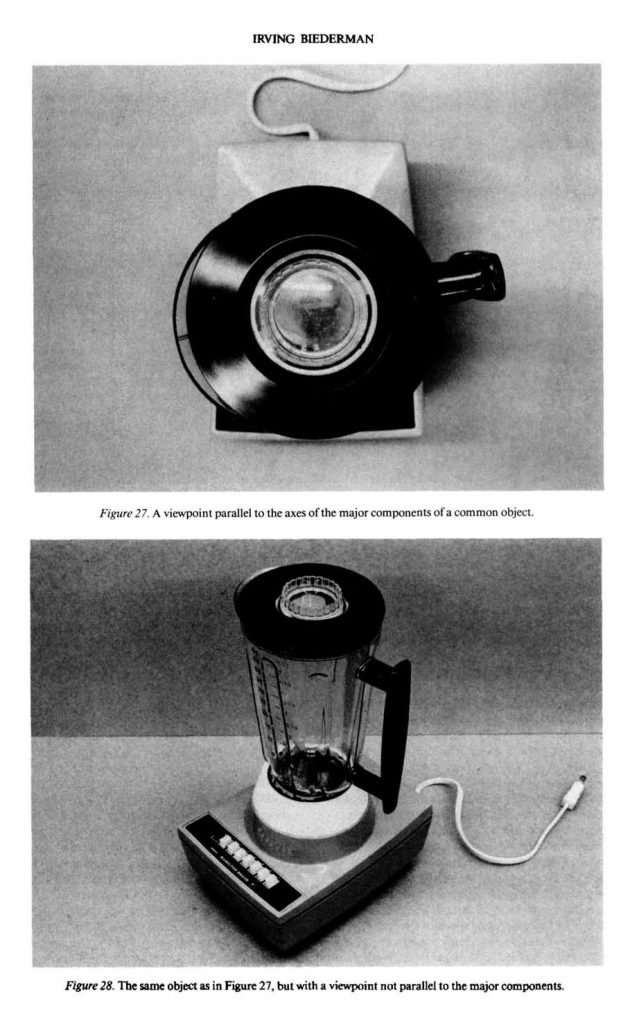
Objects can be more readily identified from some orientations compared with others (Palmer, Rosch, & Chase, 1981). According to the RBC hypothesis [Recognition-by-Components], difficult views will be those in which the components extracted from the image are not the components (and their relations) in the representation of the object. Often such mismatches will arise from an “accident” of viewpoint where an image property is not correlated with the property in the three-dimensional world. For example, when the viewpoint in the image is along the axis of the major components of the object, the resultant foreshortening converts one or some of the components into surface components, such as disks and rectangles in Figure 27, which are not included in the com- potential description of the object. In addition, as illustrated in Figure 27, the surfaces may occlude otherwise diagnostic components. Consequently, the components extracted from the image will not readily match the mental representation of the object and identification will be much more difficult compared to an orientation, such as that shown in Figure 28, which does convey the components.