


Monica K Hurdals’ ‘Flat maps of the Human Brain’
The surface of the brain is a very complicated surface with many folds (gyri) and fissures (sulci). The individual variablilty in the shape and size of the gyri and sulci of each person’s brain makes it difficult to compare brains across subjects to determine significant regions of function and activation. As a result, it is important to look at new ways to visualize anatomical and functional information.
Since the surface is so intricate and complicated, one method of simplifying the way of looking at the surface is to create a flat map of the brain. This is analagous to creating a flat map of the surface of the earth. It is impossible to flatten a surface in 3D without introducing areal and linear distortion. Nevertheless, a common way to flatten the surface of the brain is to attempt to reduce the areal and / or linear distortion between the original surface and the flattened surface.
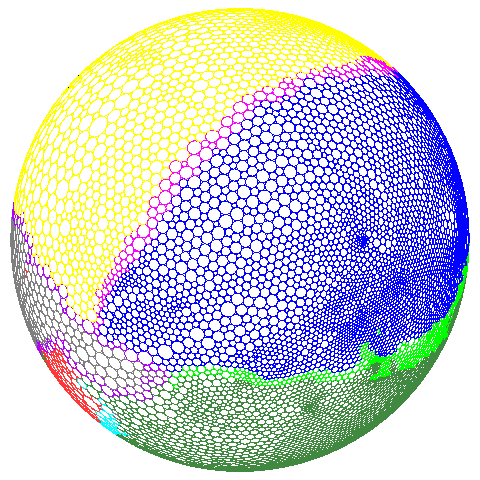
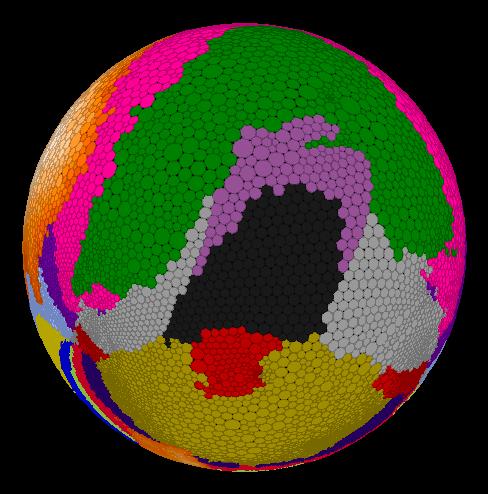
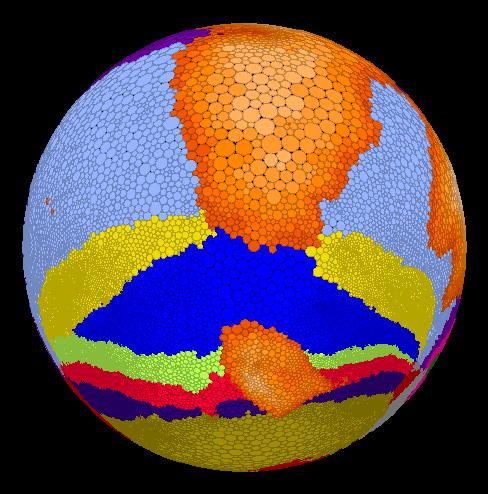
However, it is possible to flatten a surface such that the angular distortion is zero when given two points or a point and a direction (the Riemann Mapping Theorem). This is known as a conformal map (when angle proportion and angle direction between the original surface and the flattened surface is preserved). We take the unique approach of implementing the Riemann Mapping Theorem to create a map of the brain which attempts to preserve the conformal structure between the original surface and the flattend surface. To do this, we use the concept of circle packing.