
A trivial prediction about the future: THE FINALS – a forthcoming video game – is going to be a smash hit.
There are two aspects that already stand-out. Firstly the setting: it’s a multiplayer computer game that takes place in a future multi-media ‘TV show’, in which contestants compete within a holographic simulation . This self-referential tangle of simulacra is curious enough but that’s just set-up for the main pitch – an attempt to realise a long-help game developer dream: the fully destructible environment.
Some definitional house-keeping. The ‘Fully Destructible Environment‘ refers to the long-held ambition in video game development to realise levels that can be dynamically destroyed, materially reconfigured and potentially rebuilt, in real-time by players. The key principle is that this should be achieved through physics simulation – as opposed to pre-baked animation – to give players a sense of boundless agency. As Rob Runesson from the studio developing The Finals states:
“Many of us at Embark have been building first-person shooters for more than two decades, but just when we thought we were finished with the genre, we unlocked a developer’s Holy Grail”
Rob Runesson, executive producer of The Finals (via venturebeat.com)
“The World Is Your Weapon (And Enemy) – A skilled contender might go in guns blazing, but with environmental destruction in your arsenal, that’s just the start of what you can wield against your foes!
Marketing quote from THE FINALS Steam page
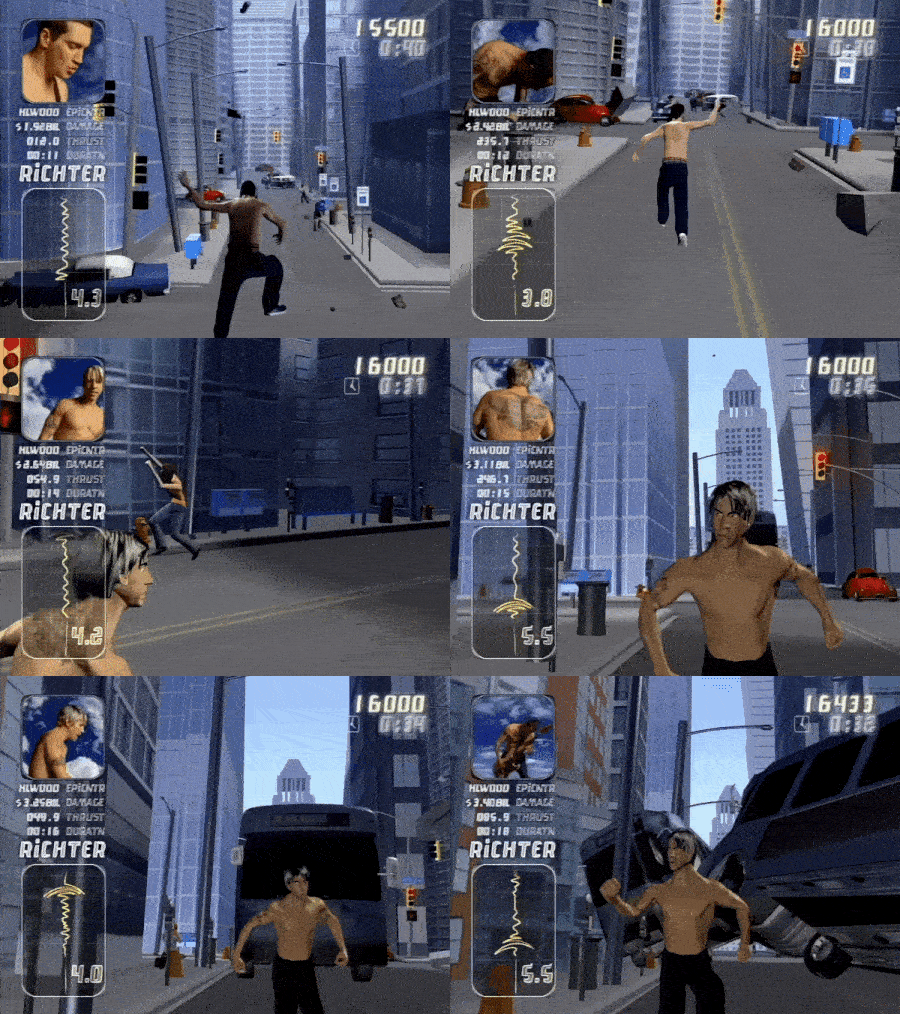
So many previous games have used such destructive potential as marketing plot without fully producing the goods, that gamers are inherently suspicious – previous attempts include, “Red Faction” (2001), which introduced “Geo-Mod” technology for real-time environmental destruction, “Battlefield: Bad Company” (2008), which popularised the concept of “levolution,” where large-scale destruction could dynamically change a map, and “Just Cause” series, which has consistently pushed the limits of open-world destruction.
Tear It Down And Start Again
The best-selling indie game Tear Down could make a serious claim for having got their first, albeit with an entirely different approach. To the casual observer, the game might be appear initially as a higher resolution version of Minecraft but in reality is the result of developer Dennis Gustafsson’s continuous pursuit of real-time simulation. The neat solution to the escalating computational complexity in destructible environments, was to express the game world as voxels or three-dimensional pixels, allowing for wildly interactive environments that not only run in real time on most hardware but also allowed for a thriving modding community to create custom levels and scenarios, massively widening the game’s destructive and constructive potential.
For those following the development of Tear Down in the years up until it’s official release, it sometimes appeared more akin to a game engine in search of a game – by no means a criticism, but more an indication of what the perceived potential of unlimited physical sandboxes might be. The result is that the game feels both highly responsive and ‘physical’ but that provides ASMR-like sensory satisfaction, as sticky chunks clump and wispy plumes of voxels evaporate. The introduction of real-time ray-traced lighting into the otherwise pixellated world gives the environment a strange uncanniness, as if experiencing hyper reality in low resolution. Tear Down is soon likely to reach a far wider audience due to the acquisition of its developer ‘Tuxedo Labs’ by Swedish media conglomerate The Embracer Group and forthcoming releases on major console platforms.
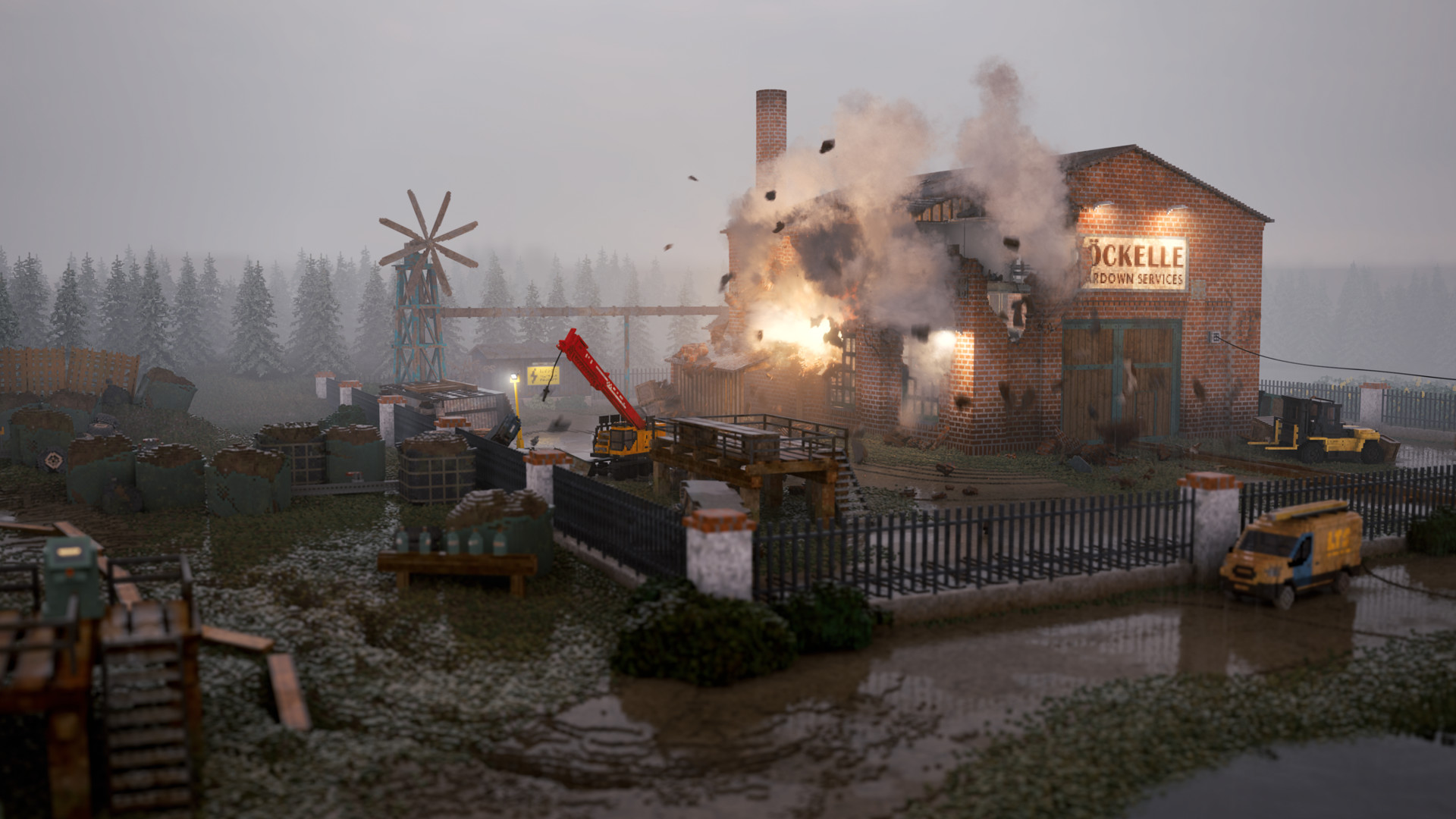
Part of it’s initial success has been the growth of a community of modders, since Tear Down presents it’s sandbox as a core component of the game, becoming in turn perhaps the most accessible realistic physical engine for other purposes. While the use of video game engines as home brew simulation environments has a long folk and research history, including both CryEngine, the GTA5 sandbox or the Quake 3 engine as primary tools, Tear Down is an increasingly popular choice for young content makers experimentally simulating explosions, battles and nuclear attacks.
By far the most popular sub-genre however is recreations of 9/11. Although such attempts might at first seem flippant or desensitised click-chasing online content, they might also be read as the method of historical engagement. Since possessing a memory of the attacks (most often as a media event for those not geographically affected) now demarcates a line between generations, the simulation of the events might represent a form of processing.
Reality Check
The utilisation of this in-game power should come as now surprise. The invention of any simulation seems to demand that it be run to logical disintegration. If we are not attacking each other (player vs player, aka PVP) then the next target will be the game environment itself (player vs environment aka PVE).
Perhaps it goes without saying however that there is deep futility in writing about destruction with respect to digital media at a moment when both ecological degradation is full flow and the reality of human conflict is nearly ever present not just in everyday streams of information but as a lived reality for many around the world.
Given the age of ecological destruction and real-world conflict in which we live, what does it mean that developers are finally realising this cherished goal now, and why was it such a long-standing goal? Living in an era when such simulations are such an important component of work, leisure, policy and everything in between may also however give us pause to reflect on a few things what it means to push them to their limits.
Simulation and strategic gaming has always been interlinked with military research and actions, from the the earliest days of flight simulation, the advent of military war-gaming in the 18th century or the contemporary drone pilot, as extensively explored but the late and highly influential artist Harun Farocki.
Not only should we keep the realities of such violence in the forefront of our minds, but we need to be especially careful to avoid demeaning it by confusing the media presentation with the underlying reality, however much the medium is massaged.
Games are of course by no means the only use of physical simulations and some of the most visceral intersections of technology are by those extending the boundaries of where simulation can be applied. For instance of the output of Forensic Architecture, most recently in collaboration with Kiev-based The Centre of Spatial Technology analysing the Russian attacks on Ukraine. Their recent work documenting the Mariupol Theatre is profound, unsettling and deeply moving, demonstrating why the toolset of digital simulation tools and ‘forensic’ methodologies provide such a unique vantage point on such tragic events.
Simulations are never neutral, nor can they be untangled from the real world political context in which they take place. On the contrary the more we investigate the simulation as a perhaps the default medium of our contemporary era we may come to understand how much they reveal about the human social psyche.
***
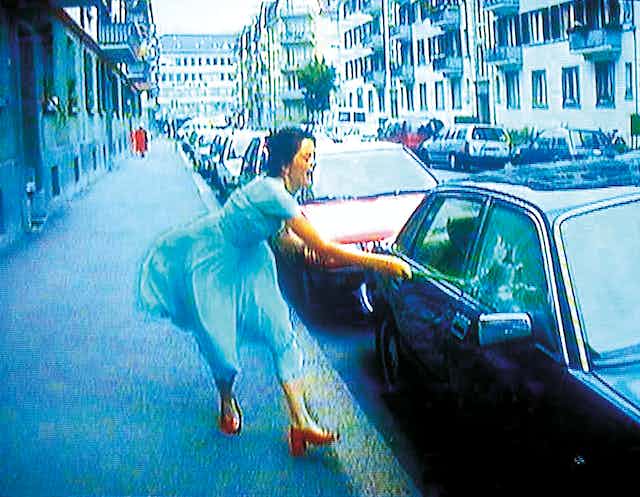
As such it might be more important than to focus on the condition of the simulation rather than meaning of its ‘destruction’. Destruction is such a prevalent motif within the histories of theatre, cinema or art, especially since the 20th Century that we can bump into seemingly pertinent references almost by accident. Some that spring immediately to mind: Pipilotti Rist “Ever is Over All“, Gordon-Matta Clarks Conical Intersect, Betye Saar’s Liberation of Aunt Jemima: Cocktail, Gustav Metzger’s auto-destruction, Basinki’s Disintegration Loops (itself a response to September 11th). All of these artworks represent a highly charged and expressive relationship to ‘destruction’ as a response to an overbearing, unjust and chaotic world.

***
Reticulating Splines
From the earliest days of Asteroids (1979), Dig Dug and (1982) through to the ultimate cash extractive simulating behemoth Minecraft (2011) – 238 million sales and counting – a large percentage of videos games rely on some sort of environmental reconfiguration, if not outright terraforming as a core mechanic. Both conceptually and narratively, environmental destruction and its consequences appear almost baked into video games as a medium.
Which might not be such a surprise given the entire development of the industry and the simulation technologies it has pioneered, have emerged in parallel with the growing scientific understanding – and political consciousness – of the ecological impacts of humanity.
1972, arguably the breakthrough year of the modern game industry saw the release of the major first hit – “Pong” alongside what is now regarded as the first home console system “Odyssey“. The latter was unveiled by it’s creators Magnavox in May 1972, just weeks before the first United Nations Conference on the Human Environment – the first international summit focused on environmental policy – in Stockholm, Sweden.

Between October 9th – 15th 1985, the succinctly titled “International Conference of the Assessment of the Role of Carbon Dioxide and of Other Greenhouse Gases in Climate Variations and Associated Impacts” convened in Villach, Austria – concluding with a decision to establish the “Advisory Group on Greenhouse Gases” (AGGG) – later reorganised as the IPCC. Three days later, on October 18th, Super Mario Bros was released in North America, kick-starting a revolution in home video games.
On 5th May, 1992, the hugely popular first-person shooter Wolfenstein 3D was released, the start of the new era of 3D game engines, spearheaded by its developer, Id software. Just four days later on 9th May, the draft text for The United Nations Framework Convention on Climate Change (UNFCCC) was finalised in New York, before being ratified later that year at the Rio ‘Earth Summit’.
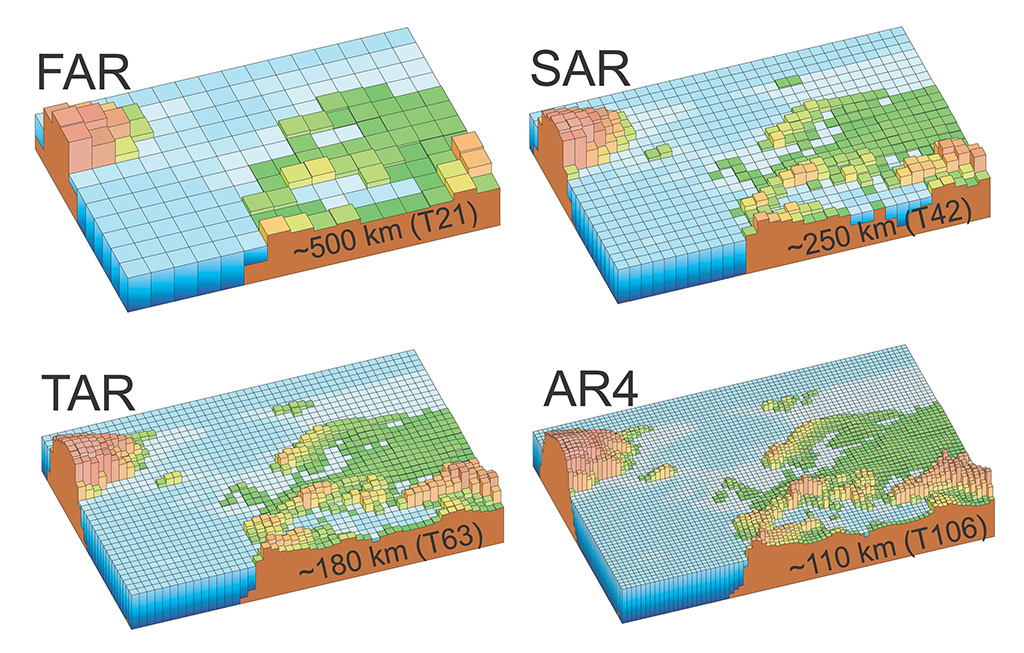
Fast forward to 1997 and the wildly popular “Final Fantasy VII”, in which the player takes on the role of Cloud Strife, who alongside an eco-terrorist group AVALANCHE, fights against a corporation named Shinra, who are draining the planet’s life energy for profit. Also released – The Kyoto Protocol.
In 2016, sandwiched between the draft and the legal adoption of The Paris Climate Agreement, Niantic released the global phenomenon Pokémon Go, a watershed in mobile and augmented reality gaming.
While these dates are cherry-picked as curious coincidences – in a 50 year window, the importance of climate science and environmental policy have expanded as seismically as market for computer games – all in their own ways downstream of an explosion in computation and network bandwidth.
Gaming The System
There is also a long history of games as direct expressions of the environmental movement, such as the 1970’s board games Smog, encouraging players to grow a city without polluting the air or Ecology: The Game of Man and Nature. Among dozens of more recent examples are Beyond Blue (an ocean exploration simulator) and Fort McMonye (2013) A ‘film meets game’ documentary by David Dufresne investigating the Canada’s oil sands petroleum industry. As a sub-genre though it can feels too worthy – see the European Commission funded: EnerCities (2011) – and potentially even just too boring to provide anything like mainstream ‘gamer’ appeal.
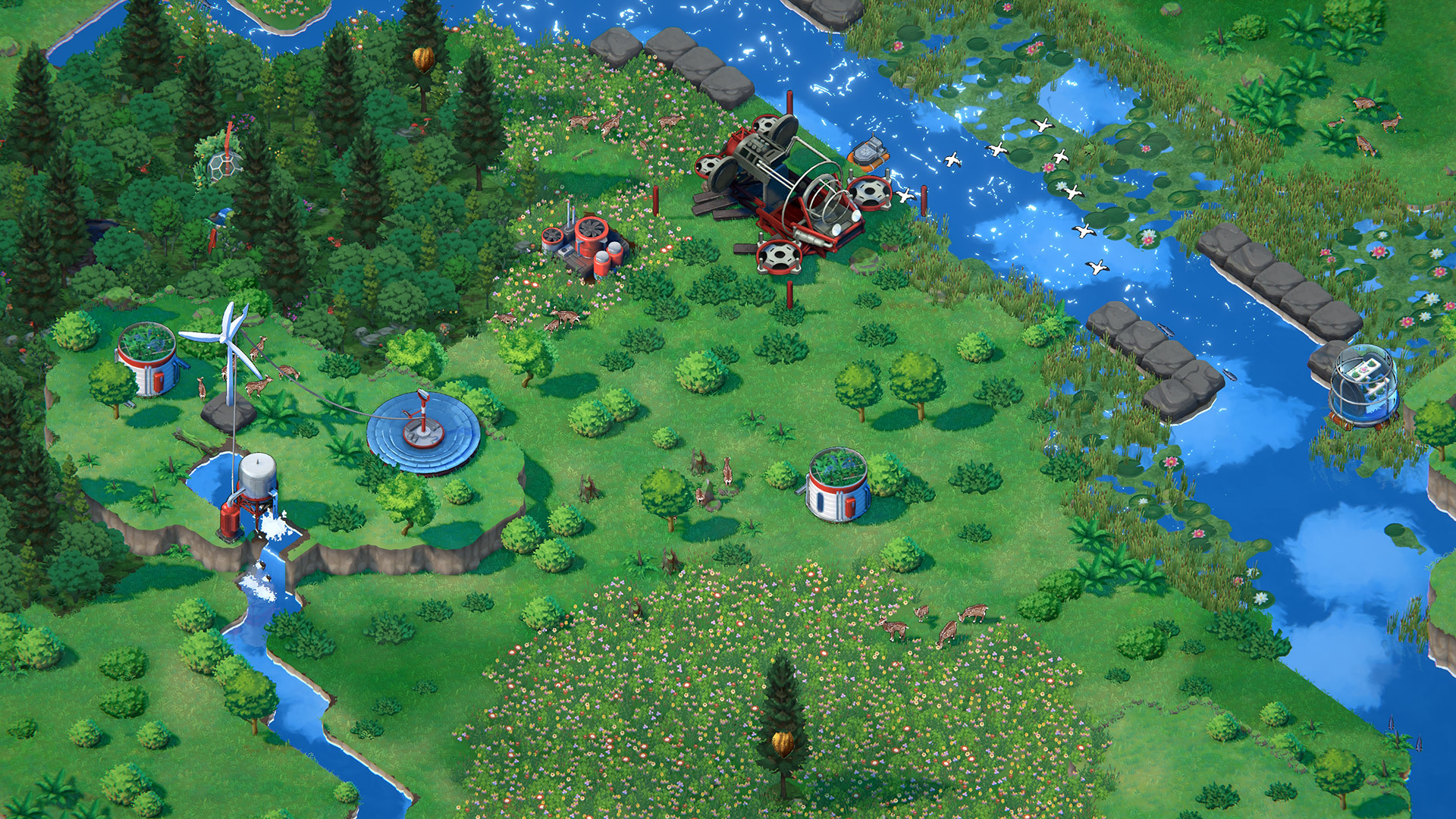
One of the few attempts to cut through is the recently released Terra-Nil from Cape Town based developers Free Lives (more on this in a forthcoming review). Terra Nil relies on the satisfaction generated from the restoration of equilibrium to an an otherwise ravaged ecosystem, through controlled fires, mangrove restoration and geo-engineering. It manages to satiate both a desire for fun and mindful reflection, although perhaps at the cost of underselling the difficulties of IRL ecosystem recovery.
Object Impermanence
Why such simulations are so compelling is complex question, but it may be that on a simple level pattern formation and recognition are so central to the nature of human cognition that we might understand such destructive tendencies as representing neural light relief. Are we gaining some great release by freeing our prefrontal cortex from the intense strain of decision-making and impulse control, or IRL moral and ethical constraints? Perhaps we in fact inhabiting a state of blissful Buddhist impermanence.
Maybe this is a self-evident aspect of play, but the act of tearing up the game space, may liberate us from the constraints of order, conformity, and societal expectations. Perhaps there’s a part of us, buried deep within our psyche, that craves a taste of this unbridled freedom – a fleeting moment of rebellion in the face of a world that often demands so much of us – the child knocking down a tower of bricks ad absurdum.
Instead we might ask if something is emerging from the potential power of simulations that is distinctly new, particularly with respect to their computation complexity that is now possible?
In Games: Agency as Art the philosopher C. Thi Nguyen makes the case for understanding games of all kinds, but including contemporary video games as being vehicles for experimenting with our own agency in different ways, and that such experiments represents the a key differentiating quality, distinct from other forms of media. He outlines the difference between “achievement play” such as “Olympic athletes who play for honor, and people who simply play to win” which is in contrast to “striving play” which “involves a motivational inversion from ordinary life“, and the temporary adoption of ‘disposable ends’ or goals we can be led at the table, like Monopoly money after game is over. Such striving within the space of a game is he posits, in search of ‘harmony’, his term description of the unique aesthetic appreciation that can be generated by games.
C. Thi Nguyen provides a neat critical framework for judging the aspirations and the artistic merit of games by considering the type of qualities available specifically within them, which he refers to as harmonies. The harmony of right in-game the solution or action, or the satisfaction of succeeding right at the edge of our capacity, that latter of which he argues is particularly rare in every day life and that it is the job of the game designer to provide space for these harmonies to ring out by finding the sweet spot where our capacity is regulate tested.
“Harmonies of capacity occur so rarely in ordinary life because so much of the world, and the tasks it forces on us, do not fit us well. There are things that we must do that are boring […] Then there are the things we must do that, though they are difficult, are also unpleasant […] There are things we must do that might start out as interesting challenges, but the world forces them on us in such mind-numbing volume that they lose all interest […] “And then there are all the tasks we wish to do that are far beyond our capacities: curing cancer, fixing the politics of climate change, easing intercultural conflict.”
C. Thi Nguyen, Games: Agency as Art
It’s noteworthy that he should specifically identify “fixing the politics of climate change” as such incomprehensibly difficult challenge as to be outside of the range of possibility for a game to successfully integrate. The player has to belief that the challenge in front of them is soluble – if only just.
C. Thi Nguyen’s books is moreover an attempt to provide a comprehensive of perspective for artistic appreciation of what makes games games, and therefor what might make good games art. Games as such a dense and broad medium that reflecting about their internal mechanisms of choice and agency is already complex, but a more broad question lingers as to whether we might we pay attention not just to content of games but the consequences of which games we choose to play in the first place. Is there any virtue in playing games which actively challenge us by showing us an ulterior model of our own real-world agency, or lack of, in the same way a reader might stick with a difficult film or long novel (or indeed essay about games) while providing a less ‘harmonious‘ experience of play? What does it mean that game experiences that often hold our attention long-term are those that might most successful meddle with our brain’s reward system in some way, flooding us with a cocktails of dopamine and adrenaline through the repetition of rewarding core loops?
Stochastic Stimulation
Our media diets are of course increasingly built around systems which capture and augment our conscious attention in various ways, appearing to dig ever deeper and more nefariously into our emotional inner lives and primordial lizard brains. While Twitter and Facebook, dependent primarily on para-social written communication have descend into weaponised rage bait, video content platforms appear to trend towards rapid fire hits that trigger autonomic sensory reactions or satisfactions , like those generated by unboxing videos, make-up tutorials, ASMR and a hydraulic press squashing a pair of crocs. The escapable of firing of mirror neutrons as we watch another 10 second clip of ‘The Hot Metal Ball‘ vs a glass of egg yolks.
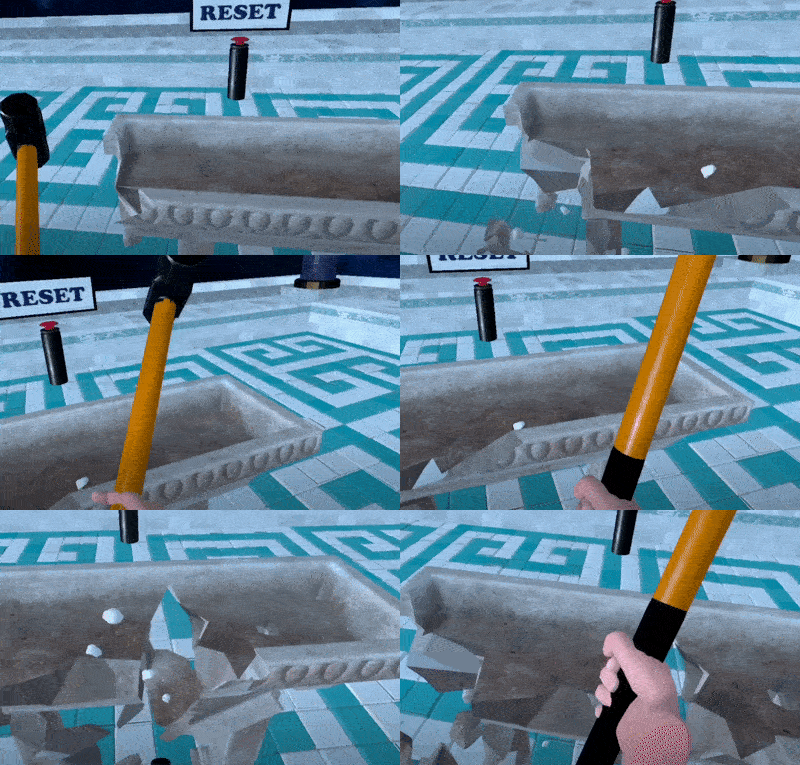
Reality techs of different flavours, i.e VR, AR, XR are taking this sensory overload to its logical, immersive conclusion. For the last decade the most chaotic landscape of of the indie game development has been VR. The competing, free-to-use game engines of Unreal and Unity have provided the community with both reliably fast physics engines and an easy roadmap to quickly shipping games, cross-platform. The resulting plethora of titles giving the user a virtualised destruction sandbox includes: StressOut, Smashing Time, Smash Hit, VR Destruction, City Destruction, Sledge Destruction Simulator, Rage Room
The last of those actually simulation of the latest evolution of the the urban micro entertainment spaces, the ‘Rage Room’. Small bookable spaces in which serve as ad-hoc collective primal anger management therapy while being live streamed on local CCTV and providing a mode of zen tranquility that, in the era of hyper capitalism, might only being achieved by smashing up an old printer with a sledge hammer.
Whether it’s a cathartic release of pent-up emotions, a momentary sense of control in an unpredictable world, or an acknowledgment of the impermanence of existence or a response to the hyper-pessimism that looms over a younger people as they discover a once cherished and essential societal institutions, economic and ecological stability in a state of ruins. While games provides a gateway into radical other agencies, how far are willing to go to simulate a near future condition of dismal ecological meltdown when the conditions of game-space require some degree of satisfaction or enjoyment in the process?
The simulation may be the primary media of the 21st century, it would also appear that we’re only scratching the surface of comprehending how we inhabit, sensorily respond, or even politically define them and their internal discontents.
The wild constructive and destructive capacity of simulations and game engines is wildly contradictory, providing us with both unfiltered, bodily, cognitive and sensory stimulation and escapism while simultaneously bringing us into an ever closer orbital observation of the tragedies of humanity, and ultimately our inability to restart the game.
***
A Brief Anecdotal Epilogue
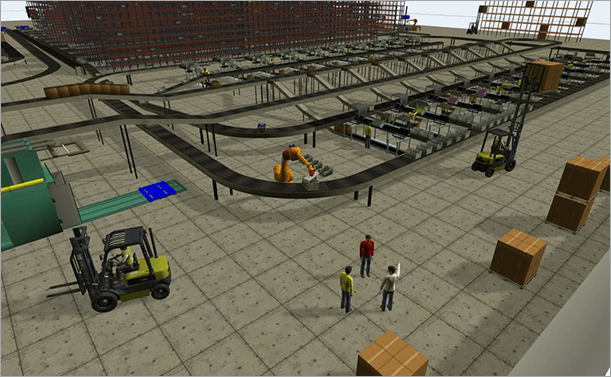
Around 2009 I was given a demo from an international building management company making digital twins of some new building management software built in OpenSimulator -the engine behind Second Life. Half way through the demonstration I and the groups of 5 other travellers suddenly found ourselves sinking into the ocean with the entire world around us having seemingly disappeared.
As it turned out the server was configured to give all visitors fully unrestricted editing access and somewhat inexplicably the entire world was grouped as a single item, something I had not appreciated as I right-clicked on it. There was a brief pause before our audibly irate but measured tour guide said, with a wonderfully strong Swiss accent: “May I ask, who has put the island into their backpack?“.
Since there was no way to restore the island without restarting the server, that was the end of the demo.