
“Limits to Growth (business-as-usual)”, Digital Artwork (2015)
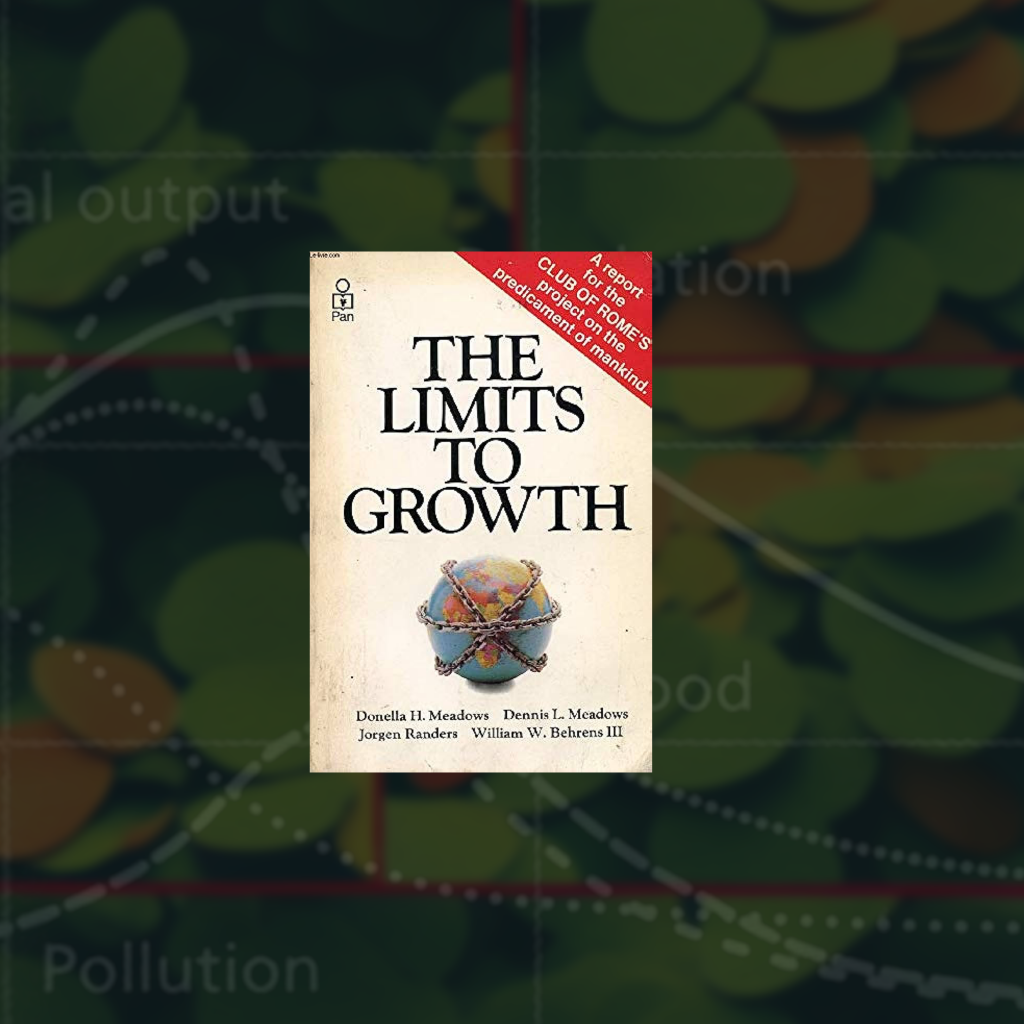
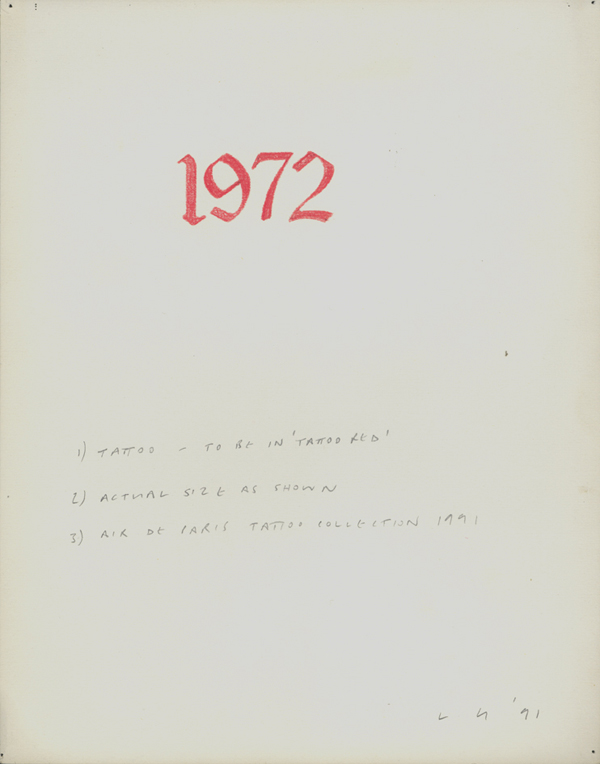
The artwork pictured was a response to the 1972 report “Limits to Growth”, written by Donella H. Meadows, Dennis L. Meadows, Jørgen Randers, and William W. Behrens III. A book review in the form of a diagrammatic mural, inspired by the various plaques produced by Nasa for deep space probes.
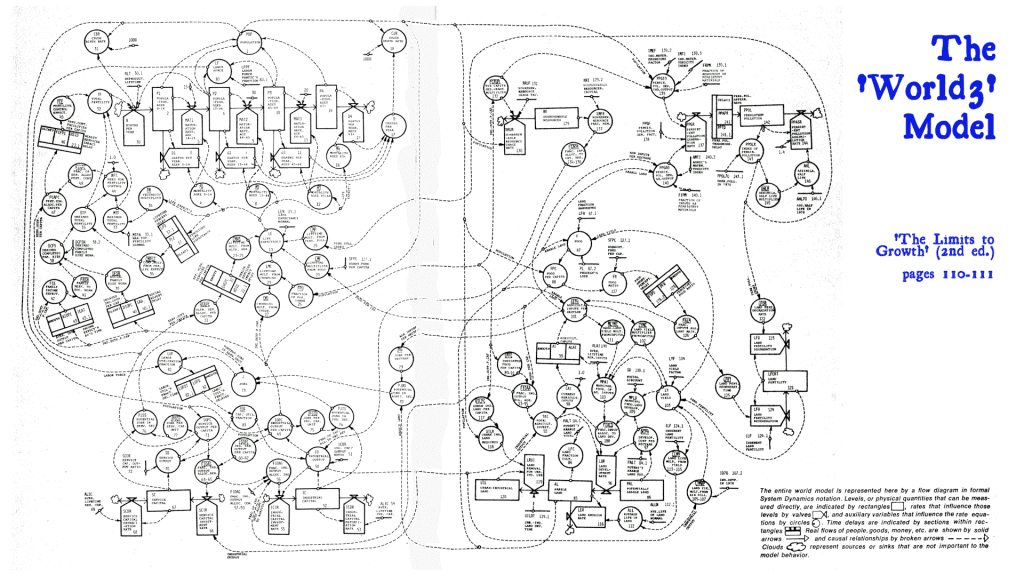
The report represents one of the first attempts to model humanity and earth, using the World3 model to calculate the interactions of between core planetary systems such food, industry, agriculture and pollution. It is best known for being hugely influential within environmental discourse and as a foundational text for the degrowth movement as a result of some of the conclusions drawn by the authors, as well as sparking critiques from across the political spectrum, provoked by not least by it’s provocative title. Even now, to invoke it as a point of reference implies some ideology or political allegiance, even if the messages and content of the book itself are often misrepresented. Reading it for the first time left a deep impression on me, not only for the clarity of it’s arguments but also in it’s simple extrapolation of the dynamics of systems, taking only half a dozen key system and demonstrating how interactions between them may behave counter-intuitively.
It is also representative of a historical moment, a shift in scientific methodology at the birth of the computer age. The report is perhaps more fully asking it’s readers to orientate themselves within a system and it’s fluctuations, striving to identify what the really key factors are, in doing so aiming to define plausible scenarios which might resemble the future.
This approach of thinking through ‘scenarios’ or attempting to envisage the pathways towards alternative futures is a very powerful design tool. It’s deeply integrated into global climate policy, most recently in the designation of 5 Shared Socio-economic Pathways (SSPs) used within the modelling of the IPCC’s AR6 report. Using the scenarios as method of forecasting within design is something we have also attempted to integrated in various research and teaching projects at Heat Island.
One of the lessons we might learn to the controversy surrounding the book is to observe that underneath the short term chaos of everyday of politics still lie deeply rooted ideas and disagreements about humanities future, representing some of the most unstable ideological fault lines. The book is a reminder that we can anchor our understanding of the world around simple but unavoidable questions which might better help us identify these divisions – for instance:
- Do you believe that technological progress will rebalance the ecological impacts of humanity?
- Would you be willing to bet the future of an ecosystem on your answer?
- How does your view of the future change if one (or many) of the trends seemingly shaping humanities development were to radically reverse?
The question of how well it’s predictions have held up continues to fascinate though. For it’s 30 year anniversary, several attempts were made, by both the original authors and other academics, to test the accuracy of the predictions made in the book. That one of the scenarios (’business-as-usual’) they outlined appears to track closely with the global situation we currently find ourselves in should perhaps not be so surprising, given they aim of providing a range of credible future scenarios. In this respect, the report is perhaps closer to Svante Arrhenius’ very earliest scientific predictions about carbon di-oxide induced atmospheric warming at the turn of the last century than the complexity contemporary climate modelling that the report would set in motion.
The core theme however – that we may be living within a decades-long “overshoot”, that we are taking too much, too fast from the eco-systems on which we depend – is no longer in any way controversial even if the various approaches to restoring a balance are. With the benefit of hindsight we can also understand that successfully predicting future crises is not the same exercise as being able to formulate requisite solutions for them, even if the former demands the we consider the latter.